Table of contents
- What is Performance Measurement?
- What's new?
- What do we get at the end of a performance measurement round?
- How do we get started?
- Why are Performance rating questions limited to four options?
- How can you reduce the need for calibration after the round?
- How do the weightings work?
- Can I have a template to get started?
Performance Measurement FAQs

- What is Performance Measurement?
- What's new?
- What do we get at the end of a performance measurement round?
- How do we get started?
- Why are Performance rating questions limited to four options?
- How can you reduce the need for calibration after the round?
- How do the weightings work?
- Can I have a template to get started?
What is Performance Measurement?
Appraising performance has long been beset my manager scoring bias and attempting to quantise the intangibles of someone's performance. With Performance Measurement we're looking to provide clear deterministic performance ratings and reduce the calibration needed when a round closes.
What's new?
A new type of Template for Talent Snapshots called a Grid Template. Grid templates let you collect performance measurement data that's formatted for decimal placement on a 9 box grid.
Grid Templates contain a new question type called Performance Rating to assist in the collection of quantifiable performance measurement data.
For each Talent Snapshot round built using a Grid Template, a new View Ratings button will be available to Managers and Administrators to show the 9 box grid and performance ratings for the cohort of employees they have permissions to view.
What do we get at the end of a performance measurement round?
Three new Performance metrics are generated for each participant in a Performance Measurement round. A horizontal and vertical axis rating between 0 and 3 (normally attributed to Performance & Potential) and an overall performance score, also between 0 and 3.
The ratings are used to plot each employee on the 9 box grid. The ratings are available in raw numerical format either from the 9 box grid page, or from the Talent Snapshot report.
How do we get started?
- First collect the questions you want to ask and formulate the guidelines you want managers to use when choosing one of the four associated performance rating options.
- Classify your questions into two groups (typically Performance & Potential) and also consider if you want to create additional themes to group the questions.
- Consider how important each question is in relation to each other, or what % of the overall score each question should be worth.
- Create a new Grid Template with the relevant information. Filling in all the additional description details will help give your managers clear guidelines and reduce the need for calibration later.
- Create a round with the new template and assign it to a small trusted cohort.
- Iterate until you're happy.
- Roll it out to staff during your next appraisal window.
Why are Performance rating questions limited to four options?
We didn't just want to say an employee was in a box. We wanted to give you the tools to see a continuum of performance and talent in your organisation. From a practical standpoint, having four options is the minimum to allow accurate decimal level plotting across the 9 cells.
From a calibration standpoint, having four options also reduces central tendency bias. Where people tend to pick the middle option by default, having four options forces the person answering to make an assertive judgement.
How can you reduce the need for calibration after the round?
Simply put, get the data right to begin with. Calibration can be significantly eased by reducing manager bias, providing clear guidelines and empowering managers with copious insight through continuous performance management.
Some examples of how you can reduce manager bias in answering Talent Snapshots:
- Recency bias: Adopt Conversations and encourage regular check-ins between Managers and their Employees.
- Primacy bias: Adopt Feedback and encourage it's review through the Summary menu when answering Talent Snapshots.
- Contrast bias: Adoption of Objectives will help focus reviews on the tasks the employee was given, and can also be reviewed through the Summary menu.
- Leniency and severity bias: Clear, well defined descriptions in the question description and option descriptions to give managers guidance on what behaviours qualify for a given rating.
- Central tendency bias: Performance rating questions have 4 options.
- Halo effect / Horns effect / Confirmation bias: Adoption of Objectives, Feedback, Conversations to build up evidence through continuous performance management best practice.
How do the weightings work?
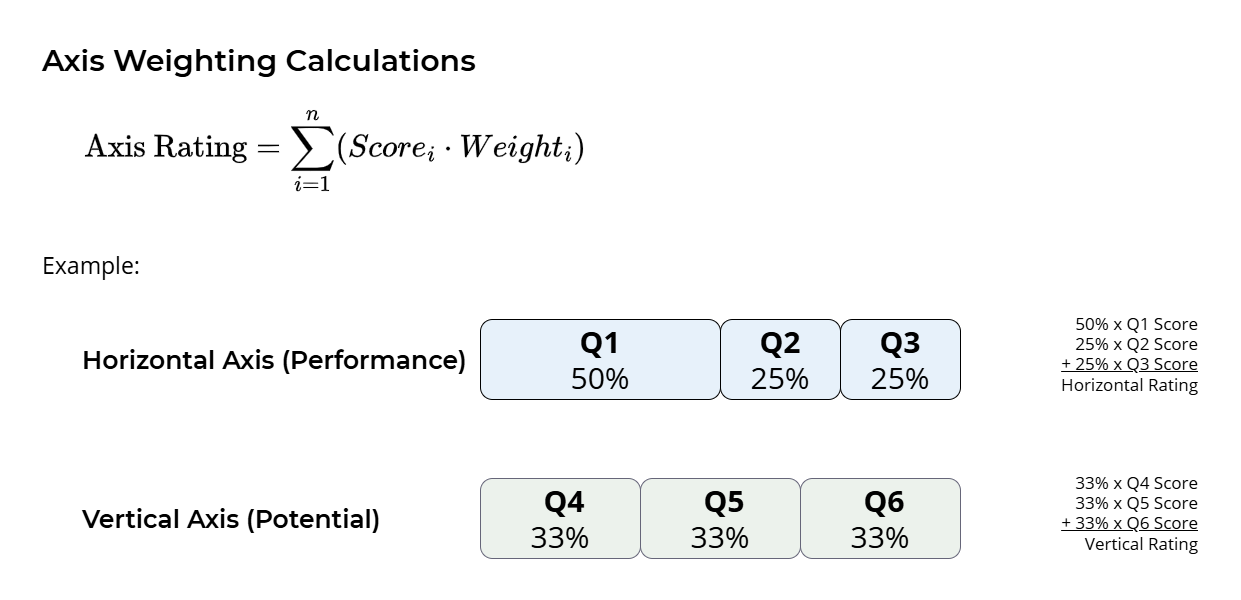
When a manager answers a Performance Rating question it produces a score between 0 and 3. That score then has a weighting applied to it based on the question weightings set in the Template. All the weighted scores for an axis are added together to produce an Axis Rating between 0 and 3.
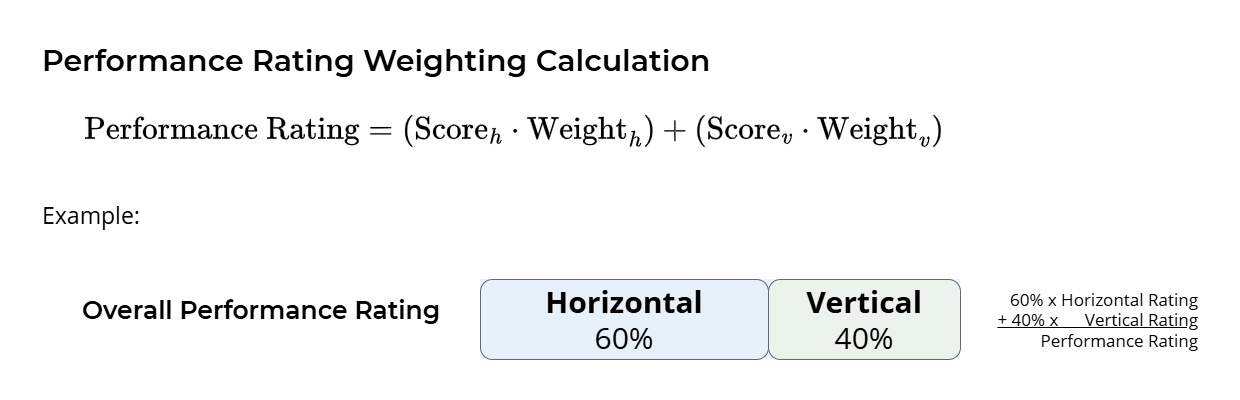
When both axis ratings are produced, each has an axis weighting applied, then are added together to produce an Overall Performance Rating between 0 and 3.
Can I have a template to get started?
Whilst we don't currently have the mechanism to provide a template, we've created an AI prompt which you can customise and use to generate a Grid Template with all the relevant details. Simply, copy the text below and amend the bold sections to meet your needs before pasting into your AI chatbot. Then use the content it generates to populate your grid template.
Prompt:
Act as an experienced Human Resources and Organizational Development specialist. Create a structured performance and talent appraisal template for managers evaluating employees. ### Appraisal Context: * **Appraisal Type / Cycle:** [e.g., Annual Performance Review, 90-Day Probation Review, Talent Review] * **Target Role / Department:** [e.g., Customer Support Representatives, Senior Software Engineers, All Staff] * **Core Themes / Focus Areas:** [e.g., Execution & Delivery, Leadership & Growth, Collaboration, Customer Impact — or write "Suggest appropriate themes for this role"] * **Number of Questions:** [e.g., 6] ### Required Output Structure: Please generate the appraisal using the exact format below: 1. **Appraisal Title:** A clear, professional title tailored to the appraisal type and role. 2. **Manager Guidance for Fair Evaluation:** A concise checklist or bulleted guide (3–5 points) reminding managers how to complete the appraisal objectively. Include specific advice on: * Avoiding common cognitive biases (such as recency bias or the halo effect) and relying on documented examples rather than general impressions. * Distinguishing between **Performance** (past/current results and execution) and **Potential** (capacity for growth, adaptability, and readiness for broader scope). 3. **Appraisal Questions:** Generate the requested number of questions, grouping multiple related questions under shared **Themes**. Ensure a balanced mix of questions assigned to the **Performance** axis and the **Potential** axis. For **each** question, provide: * **Theme:** The overarching competency category this question belongs to (multiple questions can share the same theme). * **Axis:** Assign strictly to either **Performance** or **Potential**. * **Question Text:** A clear, behaviour-focused prompt or competency statement. * **Description:** 1–2 sentences explaining what this competency looks like in practice and what the manager should consider when scoring. * **Rating Options (Single Choice):** Provide the following four rating tiers. Under each tier, write 1–2 sentences of concrete behavioural anchors describing what the employee must consistently demonstrate to qualify for that rating: * **Exceeds Expectations:** [Behavioural criteria] * **Meets Expectations:** [Behavioural criteria] * **Improvement Required:** [Behavioural criteria] * **Fails to Meet Expectations:** [Behavioural criteria] ### Tone & Style Guidelines: * Use objective, observable, and actionable language (e.g., "Consistently delivers..." rather than "Has a good attitude"). * Ensure there is a clear, logical progression of performance or potential standards between each of the four rating tiers. |
